
The switch on an angle grinder is more than a styling choice. A paddle switch and a slide switch create different operating habits, and the best fit depends on the users, tasks and market position of the tool. For a B2B buyer, the decision should be tested with actual gloves, work positions and maintenance tasks—not selected from a catalogue icon.
This article compares the two interfaces for range planning. It does not claim that either switch is inherently safe in every situation. The final tool design, relevant standards, instructions and user training all matter. Buyers should assess the exact approved model, not transfer a conclusion from a different grinder.
Define how customers will hold the grinder
Start with the customer's primary application. A fabrication shop may make repeated short cuts or grind welds at several angles. A home user may make occasional cuts with more setup time between operations. A surface-preparation operator may run the tool for longer continuous periods. These patterns affect how a switch feels in use and how likely the user is to understand the control.
Ask for an ergonomic sample review with the auxiliary handle in its intended positions, the selected guard and the accessory fitted. Test the normal hand placement with typical work gloves. The switch must be reachable without sacrificing a controlled grip. A switch that feels convenient with an empty tool on a desk may be awkward when the tool is cutting at waist level or working near an edge.
Document the test operator, gloves, task and material. Do not describe an informal handling check as a safety certification. It is a way to identify an obvious mismatch before a product range goes to market.
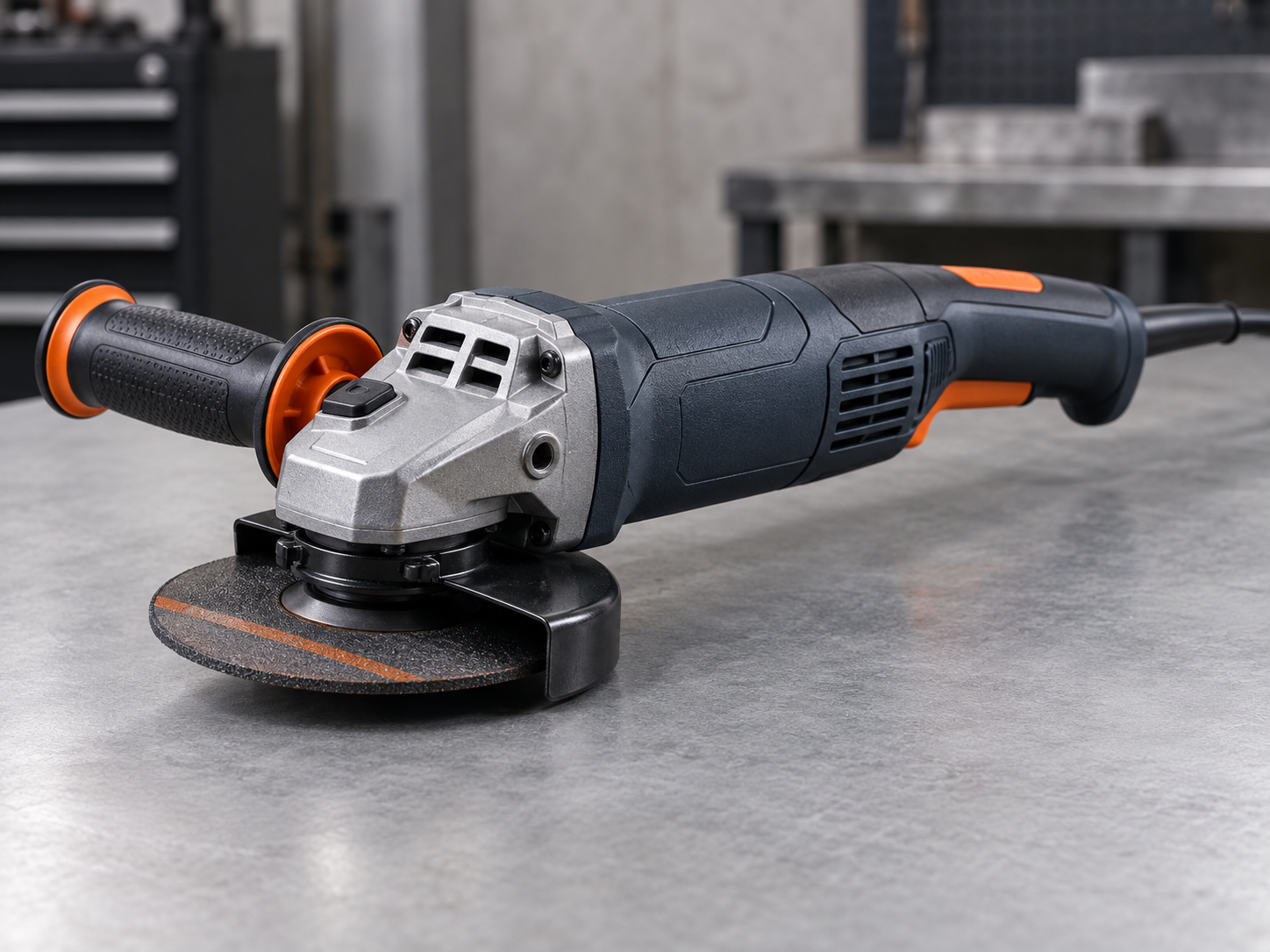
Caption: Switch choice should be reviewed with the guard, side handle and expected work posture.
What a paddle switch changes
A paddle switch is commonly designed for activation by the hand holding the tool. Depending on its exact design, it may require continuous pressure and may include a lock-off feature. Buyers should inspect how the specific mechanism works rather than assuming all paddles behave alike.
Potential advantages include an intuitive release action for intermittent tasks and a clear tactile relationship between grip and operation. Potential drawbacks include hand fatigue in long applications or awkward activation with certain glove sizes. A well-designed paddle can feel very different from a poorly placed one, so a generic pros-and-cons table is not enough for supplier selection.
Check whether users can accidentally press the switch when picking up or setting down a disconnected tool. Review the lock-off, if present, and the restart behaviour after power interruption according to the applicable product design requirements. If the target market expects a particular control arrangement, make that part of the quotation and sample checklist.
What a slide switch changes
A slide switch usually has a distinct on/off travel and may allow continuous operation on some models. This can be convenient during longer tasks, but the exact lock-on or lock-off behaviour should be specified and examined. Do not infer it from a photograph. Ask whether the switching action remains easy to understand with gloves, dust and normal wear.
A slide switch can sit in a different reach position from a paddle. This may change how the operator starts and stops the tool while maintaining grip. Verify that control use is not obstructed by the auxiliary handle, protective equipment or a typical working posture. Record whether the mechanism is sufficiently resistant to inadvertent movement during transport and setup, following the product's own instructions.
For both styles, the question is not “which one looks professional?” It is whether the control matches the real user and the complete grinder configuration.
Examine the rest of the safety system
Switch choice cannot compensate for an unsuitable wheel, missing guard or unclear instructions. OSHA's abrasive-wheel provisions describe guard principles for U.S. construction. The wheel must also suit the grinder's speed and task; see the ToolViron wheel compatibility guide.
Ask about restart protection, braking or soft start only when those features are actually present in the exact proposed model. The supplier should provide model-specific evidence and a sample demonstration. Do not turn a feature available on one SKU into a range-wide marketing claim. The manual should explain startup, shutdown and accessory changes for the approved switch configuration.
Mid-article sourcing CTA: Comparing two switch designs for a private-label range? Send your user profile, grinder size and application mix and request samples of the relevant configurations.
Build a repeatable sample test
Prepare several representative tasks rather than one long demonstration. Include a short cut, a controlled grinding pass and a tool-position change, using suitable accessories and safety measures. Have reviewers note reach, activation clarity, accidental-contact risk, hand fatigue and shutdown action. Repeat with the gloves most likely to be used by customers.
Use a structured scorecard instead of a single “good feel” judgment. Record the tool mass, handle position, switch design and sample revision, because a change in housing shape can alter the conclusion even when the electrical switch is unchanged. If possible, include both an experienced operator and someone representative of the intended retail customer, with proper supervision.
Factory testing should include the approved switch in the exact housing and controls used for the order. A component substitution can change travel or resistance. Shipment inspection can confirm switch function on sampled units, but it should not be presented as a substitute for the manufacturer's design validation and applicable conformity assessment.
Translate the choice into product copy
State the actual switch type, operating behaviour and any verified feature that affects user expectations. Avoid “safer than” comparisons unless a specific measured basis exists. Product photos should show the correct model and control. A paddle-switch image on a slide-switch listing creates a simple but serious misrepresentation.
For retailers with several grinder SKUs, explain the intended application difference plainly. For example, one model may be positioned for frequent short tasks and another for a different workflow, but the claim should come from the approved configurations and sample feedback. Keep replacement parts and manuals model-specific; service teams need to identify the correct switch assembly when assisting a customer.
The angle-grinder product page is a useful starting point for a sourcing conversation. The final switch choice should be confirmed in a signed sample and bill of materials, not assumed from a broad product-category page.
Examine the switch over a full handling cycle
A switch review should include taking the tool from its case, connecting power or fitting a battery, approaching the workpiece, making a controlled pass, releasing or turning off the tool, and setting it down after the accessory stops. Observing only the cutting phase misses several points at which a control can be misunderstood. Document what the operator actually did, not what the reviewer expected them to do.
If the model has a lock-off or lock-on feature, ask the supplier to explain the distinction in writing and demonstrate it on the final sample. Check whether the instruction illustrations match the part fitted to the production housing. A small plastic lever can change between revisions while the manual still shows the earlier part. That discrepancy should be resolved before approval.
For a cordless grinder, repeat the handling review with the battery size intended for the kit. A heavier pack can alter balance and hand position, changing switch reach. For a corded grinder, route the cable as it would be in use. A tabletop activation test alone cannot represent either case.
Ask a retailer what they can explain consistently
The best technical feature is not useful if a retail team cannot describe it accurately. Provide a short, model-specific training card that answers: how the tool is turned on, whether pressure must be maintained, how it is stopped, and whether there is a feature related to accidental restart. Do not use a universal card for a mixed range with different controls.
If the product is sold through online marketplaces, the first image should show the correct switch design. A second image can show the hand position with the auxiliary handle and guard fitted, using a realistic workshop setup. Never depict the operator deliberately bypassing a control or holding the tool by the cable. A clear photo can resolve more buyer uncertainty than a vague “ergonomic switch” badge.
Customer reviews after launch may reveal that a switch is difficult with gloves or that users do not understand a lock-off action. Analyse these reports by SKU and batch before deciding whether the solution is instruction, marketing or design. Do not claim that one complaint proves a universal defect; equally, do not dismiss a repeating pattern as user error.
Separate control preference from compliance evidence
A distributor may hear that one switch style is “required” in a market. Ask for the precise product category, standard, application and legal source behind that statement. Sometimes the real issue is a particular behaviour, such as unintended start or restart, rather than the visible shape of the switch. A qualified product-compliance reviewer should assess the exact design for the destination market. The buyer should not decide from a competitor's photograph.
Request documentation for any electronic features included in the quoted SKU. A restart-prevention feature, brake or soft-start system may interact with switch behaviour, but it is not guaranteed by the switch style. Confirm the feature on a production-representative sample and in the test file. If the supplier offers several control variants, keep their manuals and model numbers separate.
Translate the review into a sales statement that is narrow and verifiable. For example, describe that the model has a paddle switch requiring continuous pressure only if that is how the supplied sample operates. Do not say the switch “prevents all accidents.” The task, accessory, guard and operator behaviour still matter.
Create a feedback loop for the chosen design
After launch, collect complaints about unintended operation, fatigue, awkward reach and switch durability by model and batch. Ask whether the user wore gloves, what accessory was fitted and how long the task lasted. A single complaint may reveal a misunderstanding; a repeated pattern can indicate a design issue. Keep safety-related reports separate from ordinary preference feedback and escalate them appropriately.
Review warranty returns with the supplier. A switch that fails because dust enters the mechanism may require better sealing or a maintenance instruction, while a switch that is hard to reach may need a housing change. Do not promise a future design improvement until a revised sample is tested. If the control is changed, update product photos, manual illustrations and replacement part numbers before the new version ships.
This feedback loop helps a buyer build a range based on real use rather than a preference established in one meeting. It also gives retailer staff evidence to explain why a particular model is offered for a particular task.
A compact decision record for the assortment
After sample testing, write a one-page decision record. Name the customer segment, primary operation, reviewed tool and accessory configuration, switch behaviour, glove type and main observations. Record any drawback as well as the reason for selection. This helps future product managers understand why a paddle or slide design was chosen when a new supplier proposes a visually similar replacement.
If both switch styles remain in the range, make their differences explicit without ranking one as universally safer. Retailers can present the controls as different handling choices tied to specific models and tasks. The final recommendation should still be based on the customer's use, experience and the approved manual.
At shipment inspection, check sampled units for the approved switch type, clear movement and matching product information. A replacement switch component may be electrically compatible yet feel different or require another manual illustration. Treat such a change as a revision. A controlled switch specification protects the customer's actual interaction with the tool.
Frequently asked questions
Is a paddle switch always the better choice for professional work?
No. The answer depends on the exact switch design, task duration, hand position and user preferences. Compare physical samples under representative conditions.
Does every slide switch have a lock-on function?
No. Switch mechanisms differ by model. Request a written description and test the sample before writing the product listing.
Should switch feel be checked with gloves?
Yes, when gloves are expected in the intended application. Also review grip and control with the guard and side handle installed.
Can the switch be changed late in a private-label order?
A switch change can affect housing fit, instructions, testing and parts support. Treat it as a new revision requiring review, not a cosmetic substitution.
Conclusion
A useful switch decision begins with the customer's workflow and ends with a verified product configuration. Test the control in realistic work positions, record the result and keep the marketing, manual and service parts aligned with the approved model. Neither switch style can be judged responsibly in isolation from the rest of the grinder.
End-of-article CTA: Ask ToolViron for angle-grinder samples or a catalogue. Tell us whether your market favours intermittent cutting, longer grinding tasks or a mixed assortment, and which switch behaviour you need evaluated.

Caption: A model-specific sample record keeps the production switch consistent with the approved tool.
Images illustrate product and inspection topics; they are not documentary evidence of a specific ToolViron test or customer project. Confirm the exact model and market requirements before ordering.