
When a drill bit binds, the motor's reaction can turn the tool body instead of the bit. A buyer who compares only maximum torque may miss this handling question. The intended accessory diameter, material, operating mode, clutch design, side handle and user instructions all influence how a customer can maintain control. For an importer serving professional installers, side-handle fit should be part of sample approval, not a loose accessory counted at final packing.
This article is a buying framework, not an operating manual. Follow the exact drill's instructions and local workplace requirements. Some specialty drills use reaction bars or other systems that do not apply to ordinary handheld drill models. A Makita high-torque drill manual illustrates why a manufacturer may specify both a side handle and reaction receiver for its particular design; that arrangement should not be copied to an unrelated tool.
What torque reaction means in a buying brief
Torque reaction is the opposing force that the housing transmits to the user's hands when the bit encounters resistance. In normal drilling, the user controls a changing load. If the bit suddenly binds, the housing can move quickly. The perceived force depends on tool design, gear selection, bit diameter, material, grip and how the workpiece is secured. The published output-torque number does not by itself describe the worst handling event.
Define the expected task before deciding what handle and control system are needed. A compact drill making small pilot holes in timber is a different product proposition from a heavy drill driving a large hole saw through thick material. The latter may require a more substantial support arrangement and explicit restrictions in the instructions. An importer should not position a compact product for a demanding use merely because a catalogue lists a high torque value.
The starting brief should name intended materials, bit types and sizes, operator profile, duty pattern, overhead or confined-space use and expected power supply. It should also state what the retail kit includes. If a side handle is a necessary part of the approved configuration, it must appear in the bill of materials, carton contents, manual and shipment inspection.
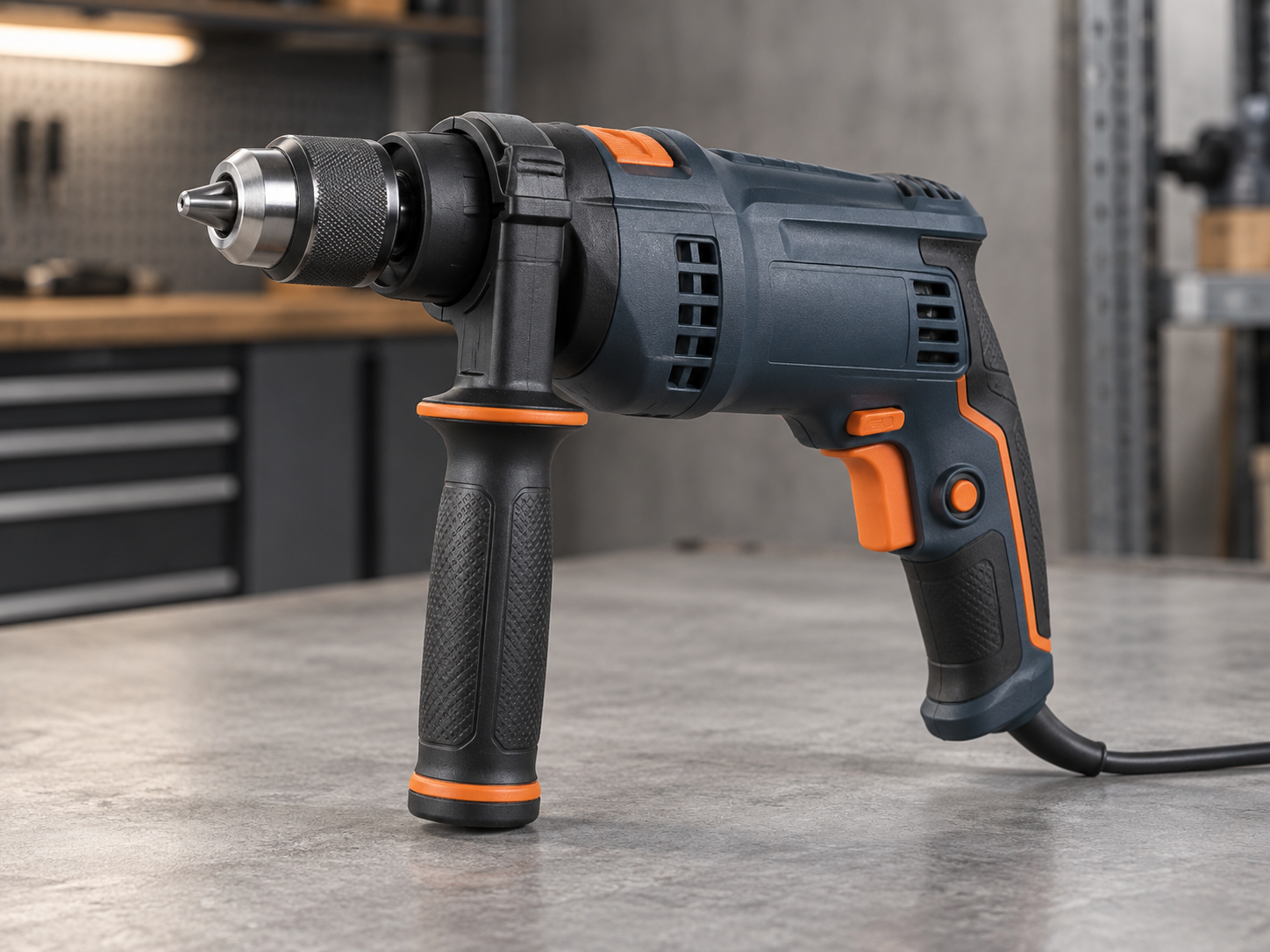
Caption: Handle geometry must be reviewed with the intended accessory and work position.
Inspect the side handle as an actual component
Look at how the handle mounts, locks and can be positioned. Can it be tightened securely without damaging the housing? Does it interfere with ventilation, controls or the intended working angle? Can a user with work gloves maintain a stable two-hand grip? A handle that appears robust in a photo may slip, rotate or loosen when attached to the production-intent sample.
Check the connection after repeated installation and removal by trained staff. If a removable handle is supplied, consider how it will be stored inside the case and whether a customer will notice it. A handle buried under packaging or omitted from an online listing is unlikely to be used consistently. It is better to present the intended two-hand arrangement clearly than to make the accessory look optional when it is not.
For a model with a clutch or bind-up control feature, ask for a model-specific explanation of what the system does and does not do. An electronic control may reduce certain reactions under specified conditions, but it cannot replace correct workholding or user preparation. Do not turn a demonstration on one material into a blanket “no kickback” promise. If the supplier uses a feature name, request a test description and confirm it on the exact sample revision.
Build a controlled handling assessment
Begin with non-powered checks: handle attachment, grip reach, switch access, weight distribution, auxiliary-handle position and clearance around the proposed accessory. Use the tools' instructions to determine permitted accessories and operating modes. A reviewer should be able to reach the controls without changing to an unstable grip. The sample should be evaluated by more than one appropriately trained person if the target channel covers varied users.
Any powered test should be planned by qualified staff in a controlled setting. Secure the workpiece, choose a task within the tool's intended use, apply correct PPE and follow the manufacturer manual. Record bit type, size, material, speed or gear, handle position, battery or mains setup and operator. The point is to observe handling during representative work, not deliberately create a dangerous binding event for a marketing video.
Compare the tool's behavior across the normal task sequence: starting the hole, steady cutting, withdrawal and change of material. Is the switch predictable? Does the bit stall under expected load? Does the handle remain fixed? Does the operator have room to keep the tool aligned? If the application cannot be performed comfortably within the product's instructions, the category or positioning may be wrong. The drill torque and RPM guide explains why load and speed choices must be considered together.
Distinguish reaction, vibration and fatigue
These are related but not identical. Torque reaction is associated with rotational load and sudden binding; vibration is oscillatory motion transmitted during operation; fatigue depends on grip force, tool mass, posture and duration. A drill can feel balanced during a five-second demonstration yet be tiring in a ceiling-installation task. Conversely, a slightly heavier drill may be easier to control for a high-load horizontal operation if its handle layout is better.
For overhead work, test reach and duration separately from the high-torque task. A side handle may be helpful in one orientation and awkward in another. The related compact drill ergonomics article offers an application-specific review. Do not present one ergonomic conclusion as universal for all body sizes or work positions.
If the supplier provides vibration or noise declarations, request their test method and model identity. Those values can inform a comparison, but they do not replace an employer's assessment of actual use. Avoid “safe all day” claims. The responsible product-page message is narrower: describe the intended use, supplied handle and recommended operating controls according to the approved manual.
Translate the result into product information
A product listing should say which accessories and handle are included, what applications are supported, and where users must consult the instruction manual. Use photographs of the exact saleable configuration. If a large hole saw is shown, verify that the pictured drill and handle are approved for it. Marketing imagery can create expectations just as strongly as a specification table.
The instruction booklet needs a clear explanation of handle installation, grip, suitable accessories and precautions for binding. Market-specific safety language belongs in the localization review. The manual and label localization checklist connects these details to importer preparation. Do not rely on a generic safety leaflet when the particular drill has a distinctive clutch or control sequence.
At carton review, count the handle, fastener or clamp parts and any installation tool required by the design. Check that the manual illustration matches the shipped handle. If a component revision changes handle fit, the tool, accessory and instructions should be reapproved together. A part substitution that leaves the drill motor unchanged can still alter the user's control.
Mid-article sourcing CTA: Planning a higher-torque drill range? Send the intended bits, materials and end-user tasks so handle and control requirements can be reviewed before sampling.
Define inspection evidence rather than a slogan
Ask the factory for a controlled specification covering handle part number, mounting interface, attachment check and finished-kit contents. A sample-test record should include observations under the intended application and the result of the non-powered fit check. A final inspector can then compare real cartons with the approved reference and verify the handle is present and secure. “Side handle included” is not enough if the production part no longer fits.
If complaints arise, record whether the handle was fitted, which bit and material were used, whether the workpiece was secured and what happened at the moment of binding. This is not about blaming the customer; it is about identifying a meaningful root cause. A loose handle, confusing instruction, unsuitable accessory bundle and genuine tool defect require different corrective actions.
Do not ask a retailer to reproduce a binding event on the shop floor. Move serious handling concerns to qualified engineering and stop making an unverified safety claim. Preserve the involved tool and accessory when an incident or near miss is reported, subject to local procedures, so the investigation can distinguish damage caused before and after the event.
Write a decision matrix for the drill range
The product manager can divide intended tasks into three bands: small controlled fastening and holes, routine drilling with moderate resistance, and larger accessories with higher potential reaction. Each band should list permitted bits, materials, user profile and the maker's required handle or control arrangement. This does not create new technical limits; it organizes limits already approved by engineering and the manual.
Use the matrix to choose the retail offer. A compact single-hand-looking drill may suit light installation, while a heavier model with a side handle may be a better match for larger hole-making. A distributor can stock both but should not use the same hero image and generic “professional drill” description for every task. The more demanding the application, the more useful model-specific evidence becomes.
Check the handle through the entire order lifecycle
At quotation, the handle must be included in the written configuration and price. At sample approval, its mounting and grip need to be evaluated. At pilot production, operators should confirm the handle, fastener and instruction insert fit the case. At shipment inspection, sampled kits should contain the correct parts. At after-sales intake, a loose or missing handle should be classified distinctly from motor failure.
These stages prevent a common documentation gap: engineering approves a safe tool-plus-handle combination, while purchasing later accepts a cheaper tool-only quote. A handle can be lost through a bill-of-materials edit, a packing change or a marketplace listing that advertises a different bundle. Control points must therefore follow the accessory through every handoff, not only the design meeting.
Test product information with a new reader
Give the production-intent manual and carton to a trained reviewer who did not attend development meetings. Ask them to identify when the handle is required, how to mount it under the instructions and which pictured bits or attachments are permitted. If they cannot find the answer quickly, the customer may not either. This is a usability check on documentation, not a substitute for formal compliance review.
The review should also find contradictions. A carton might show a large accessory while the manual limits that model to a smaller one. A translated manual might omit a warning present in the English version. A marketing page might describe “kickback-free” operation while the technical file only supports a narrower control feature. Resolve these mismatches before launch rather than relying on a disclaimer after an incident.
Use complaints to revisit the original task boundary
If several customers report abrupt housing movement, compare their actual bit sizes, material and drilling position with the intended use approved at launch. The product may be sound but marketed for an application outside its design; or the supplied handle or control may differ from the sample. Both possibilities need evidence. Do not assume one explanation before inspecting a returned unit and the listing customers saw.
This review can lead to a safer and clearer range: a different drill for large accessories, revised product imagery, better handle inclusion or a genuine engineering correction. The goal is to match the tool to the work, not to defend a headline torque figure.
Frequently asked questions
Does every drill need a side handle?
No. The need depends on the tool design and intended task. Buyers should follow the specific manufacturer's instructions and assess the accessory range and user profile rather than applying one rule to every compact or high-torque drill.
Can an electronic clutch eliminate torque reaction?
No control should be described as eliminating all reaction. Ask what event the feature detects, how it behaves on the exact model and what handling precautions remain in the manual. Confirm marketing language against test evidence.
What should be checked during sample approval?
Check handle fit and retention, control reach, permitted accessories, workpiece setup, a representative application and the consistency of labels and instructions. Record the model and revision so later production can be compared with the approved set.
What if the side handle loosens during normal work?
Stop using the affected sample and investigate the mounting design, fastener condition and installation method. The supplier should document the cause and verify any correction before the configuration is released for production.
Conclusion
Torque reaction is a product-system question, not a single number on a datasheet. Define the job, inspect the handle, observe a safe representative task and keep the shipped kit consistent with its instructions. A buyer who does that can make a more credible trade-tool decision and give customers clearer first-use guidance.
Send your requirements
Tell ToolViron which drill applications, accessories and regional markets your range must support. We can discuss the sample, handle and inspection checkpoints needed for a controlled programme. Send your requirements to start.

Caption: The final carton must contain the handle and instructions approved during sample review.
Images illustrate product and inspection topics; they are not documentary evidence of a specific ToolViron test or customer project. Confirm the exact model and market requirements before ordering.