
An impact drill and a rotary hammer can both make holes in masonry, but they address different work patterns. An impact drill combines rotation with a mechanical percussion setting and is useful when a buyer needs a versatile drill for occasional brick or lighter masonry work. A rotary hammer uses a dedicated hammer mechanism and a matching bit holder for repeated holes in harder concrete. The correct choice follows the material, hole schedule, operator and accessory system.
For a distributor, this is a positioning decision before it is a purchase order. A retailer who sells an impact drill as a substitute for a concrete-focused rotary hammer invites disappointed customers. A trade catalog that lists both without explaining the difference makes the same mistake in another direction. This guide provides a practical comparison method without assuming that one tool is universally superior.
Start with the actual hole schedule
Ask the buyer for the material, expected hole diameter, approximate number of holes per task and how often the task repeats. A homeowner mounting a few brackets in brick has a different need from an installer making repeated anchor holes in concrete. The accessory and operator experience matter as much as the tool body. A sample test should therefore use the intended bit, realistic material and a work pattern that resembles the eventual customer’s job.
Separate masonry from reinforced concrete in the brief. Brick, block and concrete have different resistance, and aggregates can change the feel of a hole even within the same site. The buyer should not promise an exact holes-per-minute figure without defining the substrate and bit condition. Bosch Professional’s drilling material guide distinguishes masonry and concrete bits and explains why bit selection changes performance.
The application should also state whether the tool must drill wood and metal. If the same buyer expects one product to handle wood, metal and occasional masonry, an impact drill can be a coherent offer. If concrete drilling is the central reason for purchase, a rotary hammer may be the more defensible category. The product description should say this plainly and avoid a vague “all materials” claim.
A practical briefing example
Consider a hardware distributor serving installers who fix cable trays in mixed buildings. Some jobs are brick walls; others are structural concrete. A useful brief identifies the proportion of each task, common anchor diameter, power access and whether the installers already own compatible bits. That brief may justify two products rather than a single model with ambiguous positioning. It also tells the supplier what to demonstrate during sampling.
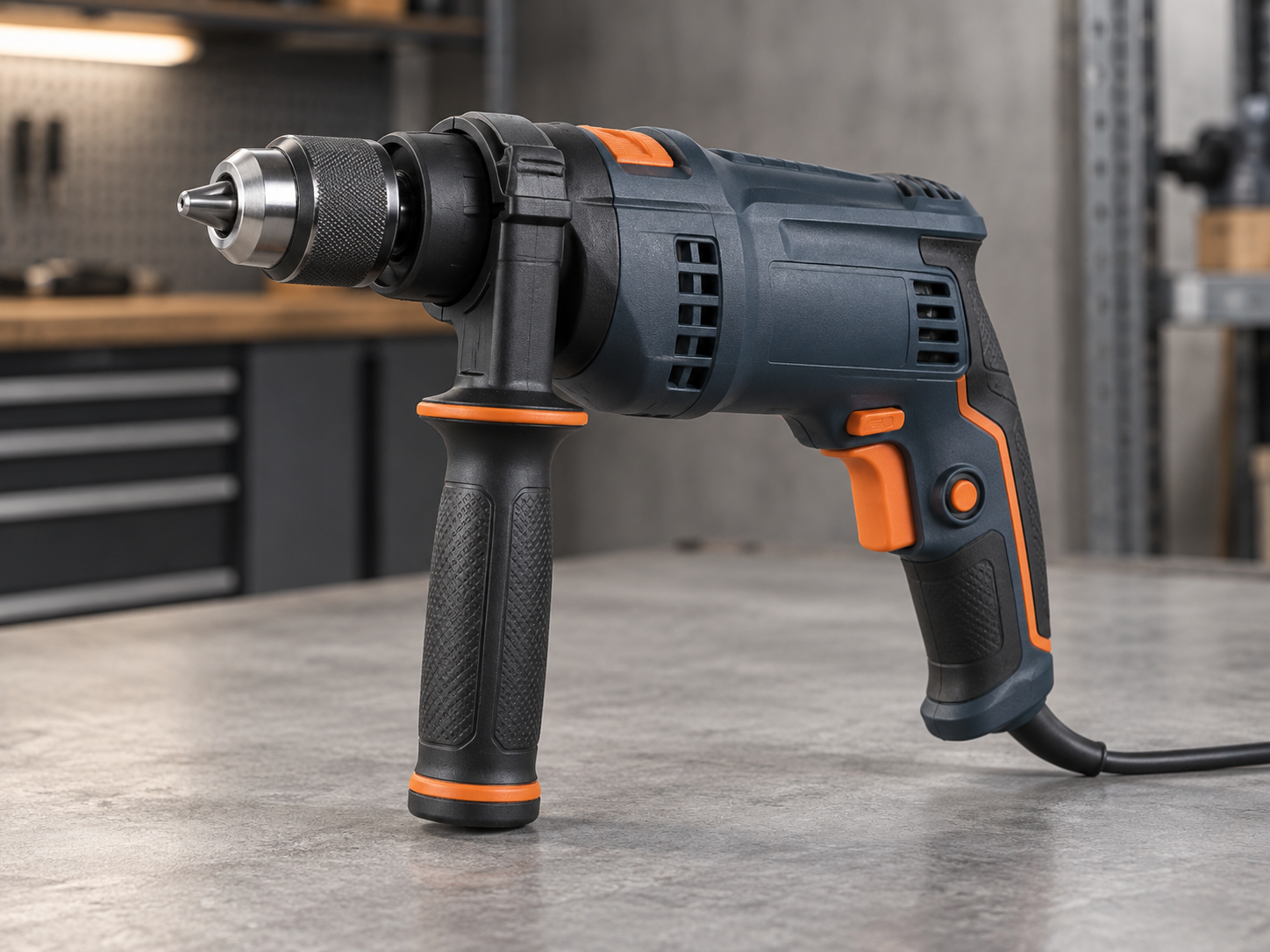
Caption: The target substrate and bit interface should be defined before comparing drilling tools.
Understand the mechanism without over-selling it
An impact drill uses a hammer setting that adds axial percussion while the chuck rotates. Its familiar chuck can support a range of conventional bit shanks, subject to the model and accessory specification. The buyer should check the mode selector, side handle, chuck, switch and intended duty. A rotary hammer uses a mechanism built for stronger repeated impact and commonly uses an SDS type bit holder. The exact modes and bit system vary by model, so the product specification must identify them rather than relying on a category label alone.
Bosch Professional describes its rotary hammer range in terms of the hammering mechanism, concrete application and specialised bit holder. This is useful context for a buyer; it is not evidence that every rotary hammer will outperform every impact drill under every condition. A fair comparison requires two configured models, the correct bits, the same material and an observed task.
Different mechanisms also create different user expectations. If a buyer chooses an impact drill for versatility, the sales page should make clear that masonry is one part of its intended work. If a buyer chooses a rotary hammer for repeated concrete holes, the box should identify the compatible bit system, supplied accessories and mode limitations. Ambiguity here becomes an after-sales question later.
Compare the complete tool and bit system
A drill cannot be evaluated separately from the bit that transfers its work to the material. A worn or unsuitable bit can make a good tool look weak. The specification should list bit interface, recommended bit type, supplied bits if any, and what the user must buy separately. For a concrete-focused offer, the buyer should also consider bit availability in its market. A product with a specialised holder but no local accessory route may be difficult to support.
The sample comparison should record the bit brand or type, nominal diameter, material, hole depth and whether the bit was new or used. If one sample is tested with a fresh carbide-tipped bit and another with a worn accessory, the result is not useful. An appropriate bit can also affect dust, heat and hole accuracy. The aim is not to create a laboratory claim; it is to make a procurement decision with traceable observations.
For a bundled kit, specify the accessory material and packaging. A “five-piece bit set” is not a complete description. The buyer should know which bits are for wood, metal or masonry, their shanks, the storage method and whether the instruction sheet explains selection. The related drill bit material guide can help structure that accessory discussion.
Read specifications in context
Rated input power, no-load speed, impact rate and drilling capacity are useful fields, but they cannot be read as a single ranking. A higher no-load speed does not necessarily indicate better work in hard masonry. A maximum hole capacity is not an invitation to use the tool continuously at that diameter. The buyer should ask the supplier how each figure was determined, which accessory and material it assumes, and whether it applies to the exact offered configuration.
The operator-facing details also deserve attention. Inspect the auxiliary handle, balance, trigger control, reverse direction, mode selector and cable or battery arrangement. A tool that feels acceptable for one occasional hole may be tiring during a full installation shift. Conversely, the weight and specialist bit system of a rotary hammer may be unnecessary for a small home-maintenance range. The task determines which compromise is sensible.
When an advertised claim appears on the carton, it should match the approved sample and product information. If a supplier revises the chuck, bit holder, motor or accessory bundle, the marketing copy may also need revision. This is why a controlled configuration record is more useful than a photograph with a few large numbers.
Plan a sample test that answers the buying question
Use a test board with representative brick and concrete samples where practical, and record the method. Fix the workpiece or worksite conditions, use correct personal protection, and follow each tool’s instructions. The buyer can compare startup control, hole progression, bit fit, handling and dust-management options. Do not force either tool beyond its stated application simply to produce a dramatic comparison.
Observe the pauses as well as the drilling. Does the mode selector make sense to a new user? Can the bit be fitted and removed without confusion? Does the side handle give a secure grip? Is the supplied case or carton appropriate for the channel? These details affect installation preparation and returns but rarely appear in headline spec tables.
Record the result as a buyer decision, not an absolute performance verdict. For example: “The impact drill was acceptable for occasional holes in the specified brick sample; the rotary hammer gave a more comfortable repeated-hole workflow in the tested concrete.” That statement is bounded by the test conditions. It is more trustworthy than an unsupported claim that one mechanism is always “professional” and the other is not.
Mid-article sourcing CTA: Building a masonry-tool range? Send your target material, hole schedule and destination market to discuss a suitable drill configuration and sample plan.
Decide what each sales channel should receive
A hardware store may need a clear entry product, a short accessory explanation and a visible step-up option. A specialist contractor distributor can support more detailed bit compatibility information, replacement accessories and application notes. An online listing needs concise selection language because the buyer cannot ask a counter salesperson. The same tool may require different presentation, but the underlying claims and box contents must stay consistent.
Create a comparison table for the channel rather than a ranking by power alone. Recommended columns include intended material, typical work pattern, bit interface, supplied bits, power source, box contents and support route. The result should allow a buyer to answer “Which should I choose for my work?” in one short conversation. It should also make clear what is outside the intended use.
Think about adjacent products. A range containing an impact drill and a rotary hammer should not describe both as a generic “hammer drill” without further detail. Use distinct names and product images, and explain the compatible accessories. This reduces keyword overlap between product pages and helps search engines understand why each page exists.
Build the factory testing and packing reference
The supplier’s production checks should match the chosen model. Ask how function, mode selection, switch operation, chuck or bit-holder fit, visible finish, labels and accessory contents will be confirmed. A factory testing plan should also identify what happens when a unit does not meet an agreed check. It is not necessary to claim that every unit undergoes every possible test; the buyer needs a relevant and reviewable process.
Shipment inspection then compares finished goods with the approved configuration. Inspect the product identity, power arrangement, handle, selected chuck or bit holder, supplied bits, instructions, labels, carton and quantity. Give any third-party inspector the sample approval reference and acceptance criteria before the visit. The ToolViron quality overview is a starting point for discussing such checkpoints.

Caption: A sample review should record bit fit, mode selection and the agreed application before shipment inspection.
If the product is private labelled, confirm that box imagery matches the actual accessory and mode configuration. An attractive carton showing a case or bit set that is not included is a preventable customer complaint. The same review should include manual language and destination-market information. Where regulatory obligations apply, the importer should confirm the product-specific requirements with qualified advisers.
Use after-sales feedback to refine the range
After the first shipment, collect questions by application. Are customers asking whether the impact drill can perform repeated concrete holes? Are they buying the wrong bit for a rotary hammer? Do they understand how the mode selector works? These questions can show that the product itself needs a different position, or that the listing and instructions need clearer language.
Keep records by model and market variant. A complaint about a specific bit holder, plug or accessory bundle cannot be investigated effectively if the team only knows the broad product category. Link the feedback to the approved sample and packing record. Then decide whether to change the tool, bundle, description or retailer training for the next order.
The objective is a range that customers can select confidently. That is also a practical SEO benefit: the article answers a real comparison question while the product pages remain focused on the precise tools ToolViron can discuss with buyers.
When a two-model assortment makes more sense
A distributor does not have to force every masonry customer into one tool. A compact impact drill may serve mixed household tasks, while a rotary hammer can address buyers whose regular work involves concrete anchors. The assortment can share a clear price ladder without pretending that the products are interchangeable. Define the entry model by the applications it can genuinely handle, then position the heavier-duty model around the material and hole schedule it is designed for.
The product manager should ask sales staff what questions buyers actually bring to the counter: “Will this drill make several anchor holes in reinforced concrete?” is different from “Can it occasionally drill into brick?” A sales aid can route the customer by substrate, hole size, frequency and bit interface. Avoid an absolute material claim because aggregate, reinforcement, bit quality and technique affect results.
If the two tools use different bit systems, make that visually explicit. Place the compatible bits beside each model in product photography and state which are included. A customer who buys a rotary hammer and later discovers that an existing round-shank accessory does not fit the supplied chuck may feel misled even though the tool itself is functioning correctly. Include any approved adapter only if it is part of the exact package and its use is documented.
Procurement questions that expose hidden costs
Ask how often the targeted customer will replace bits, what consumables the channel stocks and whether the tool is likely to be rented or shared. A lower purchase price may not mean a lower cost per completed hole if the tool is used far beyond its intended workload. Conversely, a rotary hammer can be an unnecessary burden for a buyer who mostly drives screws and occasionally works in softer masonry.
Check the supplied case, depth stop, auxiliary handle and manual. A missing depth stop can affect anchor-hole consistency; a missing handle can change how the customer controls the tool. If a proposed kit includes several bits, verify their shank system and intended substrate. These small components are often where a promising sample and a disappointing retail package diverge.
Finally, ask the supplier to describe its change-control process. A motor, gearbox or chuck revision may change the customer's experience even if the exterior appears identical. Preserve the approved sample and test record, then compare production units against the attributes that led you to select that model in the first place.
Frequently asked questions
Is an impact drill the same as a rotary hammer?
No. Both may combine rotation and percussion, but a rotary hammer uses a dedicated hammering mechanism and a specialised bit holder for repeated masonry work. Compare the exact models, bit systems and intended task before choosing.
Can an impact drill be sold for concrete drilling?
That depends on the model, bit, concrete and workload. An occasional light task is different from repeated anchor holes. Product information should describe the supported application and avoid a blanket promise.
What should a distributor include in a comparison sheet?
List the intended material, drilling pattern, bit interface, supplied accessories, power source, handling features and support route. Include the sample test conditions behind any performance claim.
Does a rotary hammer replace a conventional drill for wood and metal?
Some models have modes and accessories for other materials, but the exact capability and holder arrangement vary. Confirm the configuration and instructions before presenting it as a multi-material tool.
Conclusion
Choose between an impact drill and rotary hammer by defining the customer’s masonry task, bit system and repeated-use expectations. Validate the proposed tool with realistic material and the correct accessory, then make the product distinction visible in the catalog, carton and sample approval. A clear scope gives buyers a stronger basis for quotation, factory testing and shipment inspection.
Send your requirements
ToolViron can discuss a drill brief for your target market. Share the intended material, common hole sizes, expected use pattern, destination, accessory plan and order estimate. Send your requirements to start a configuration and sample conversation.
Images illustrate product and inspection topics; they are not documentary evidence of a specific ToolViron test or customer project. Confirm the exact model and market requirements before ordering.