
The first minutes after an electric chainsaw leaves the carton are decisive. A customer may not know that the chain needs a model-specific tension check, that bar-and-chain oil is required, or that a battery and charger may be sold separately. A retailer who treats setup as obvious can create avoidable support calls and safety concerns. The solution is not a tiny leaflet replacing the manual. It is a saleable kit and first-use path that make the required checks visible.
This article is for importers and retail product teams, not an operating lesson. A chainsaw can cause serious injury. Follow the exact manufacturer's manual, local training and PPE guidance. Husqvarna's battery-saw maintenance checklist shows the breadth of pre-use checks that can apply to a particular model, including controls, chain, bar and oil; another electric saw may specify a different sequence.
Begin with a complete box-content record
List the saw body, guide bar, chain, bar cover, battery and charger where included, cable or plug for corded models, oil if supplied, adjustment tool, manual and any accessories. A customer should be able to compare this list with the opened box. If chain oil is required but not included, state that clearly in the listing and on an accessible insert. Do not show a bottle in marketing photography unless the saleable kit includes it or the image identifies it as separate.
Confirm that the power source matches the destination market. For a battery saw, record the battery and charger model and approved pairing. For a corded saw, confirm voltage, plug and cable details. A visually correct saw body with the wrong regional charger or plug is not ready for retail. This is a configuration and shipment-inspection issue, not something customer support should discover later.
The manual and label localization guide helps plan market-language and identity checks. A simple first-use card can direct the buyer to critical manual sections, but it should not contradict or replace them.
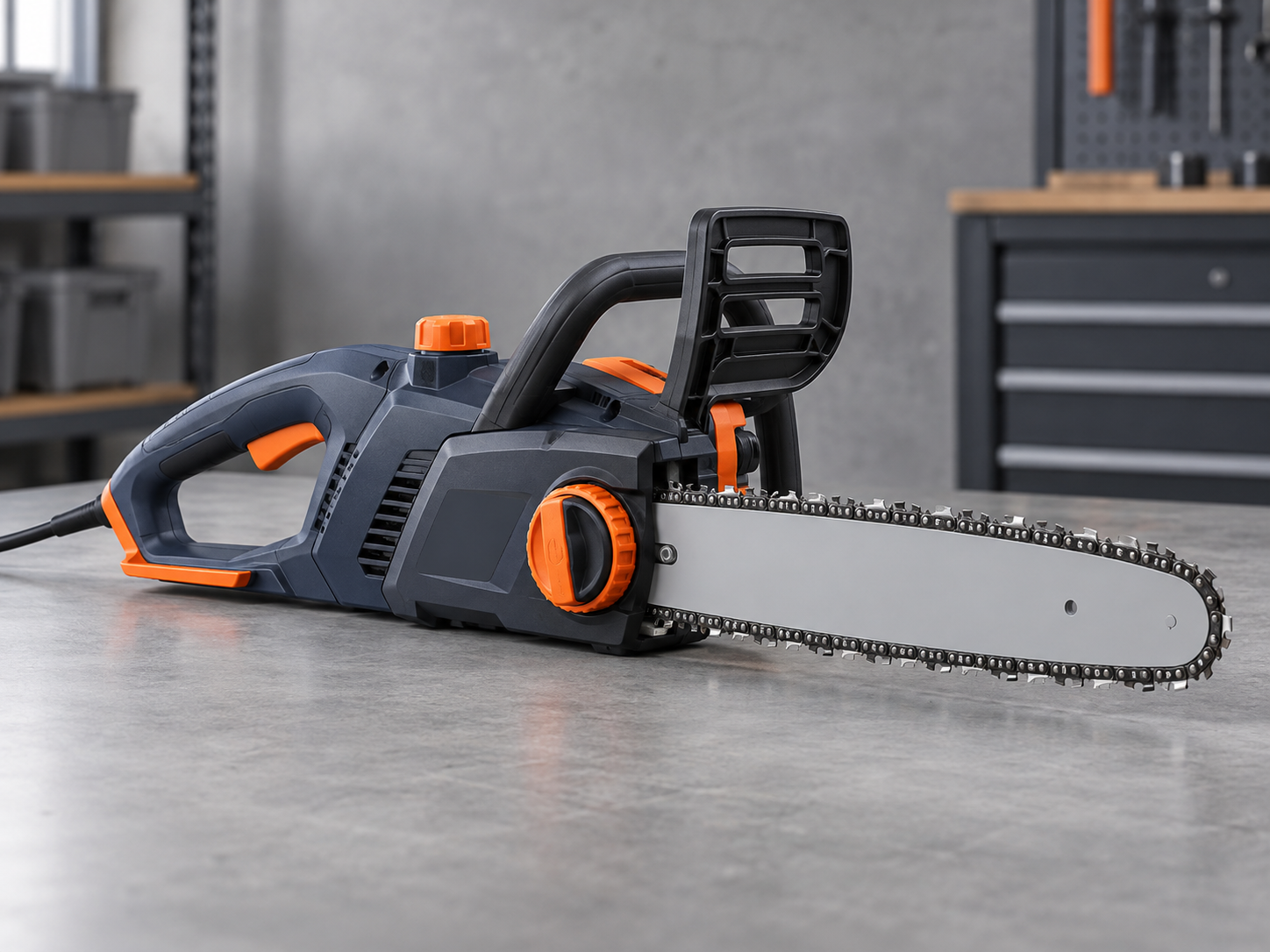
Caption: First-use preparation begins with the real box contents, not an idealized product photo.
Explain the pre-power checks
Before a user connects power, the manual should guide inspection of the chain and bar installation, tension, oil level, guard and controls. The method is model-specific. A loose or over-tight chain, missing oil or incorrectly seated bar can turn a routine first cut into a problem. The retailer should make the required setup understandable with diagrams and clear part names rather than assume the unit arrives fully ready to cut.
Protective equipment must be addressed honestly. Eye and face protection, hearing protection, suitable gloves, leg or foot protection and other items may be needed according to the task and local rules. Product photography should not suggest that an electric power source removes cutting hazards. A guided retail conversation can point customers toward training and proper PPE without pretending the saw is safe for every user.
The worksite matters too. A customer should know that unstable timber, bystanders, poor footing and overhead hazards are not solved by selecting an electric motor. The manual and local training are the authority for cutting technique. A first-use card can say “read the operating and kickback sections before cutting,” not offer a compressed substitute for professional instruction.
Make the oil system visible
Many electric chainsaws require bar-and-chain oil even though they have no petrol engine. The oil tank, cap and oil-level indicator should be identified in the instructions. If the kit is shipped dry, the buyer must know what approved oil to obtain before first use. If the seller includes oil, confirm the bottle and packing are suitable for the market and transport route.
Use the maker's procedure to check lubrication. Do not instruct a customer to run the chain dry to test the motor. A no-oil complaint may be a missing consumable, blocked passage, wrong oil, leak or actual pump issue. Retail support should distinguish these cases. The bar-and-chain oil-system guide gives a deeper product review.
At factory packing, verify the oil cap is secure and any shipping plug or protective piece is handled according to the approved process. The carton should prevent an oil bottle, if included, from contacting a sharp chain or battery terminal. Packing is part of setup quality.
Control chain and bar information
Identify the factory-fitted chain and bar by part number and dimensions. A retailer should know where a customer can obtain a replacement. A bar-length label alone cannot identify a chain; pitch, gauge and drive-link count matter. Link the replacement matrix from the listing or manual so a first-time buyer can find it later. The chain stock-planning guide explains that after-sales record.
Check whether the chain is fitted at the factory or must be installed by the customer. These are different onboarding paths. If installation is required, the manual must contain model-specific instructions and warnings, and the carton should protect the loose parts. A generic saw photo showing a fitted chain can misrepresent the actual first-use work.
If a tool-free tensioning feature is advertised, test the saleable revision with the supplied bar and chain. The customer should be able to identify the correct control and understand that tension still needs checking. “Tool-free” is not “maintenance-free.” The chain-tensioning systems article covers the selection trade-off.
Mid-article sourcing CTA: Preparing a first-time chainsaw retail kit? Send the box contents, market and onboarding questions for a configuration and manual review.
Validate the first-use journey with a sample
Have appropriately trained reviewers open a production-intent carton without prior verbal coaching. Ask them to list the supplied items, find the correct manual section, identify oil and power requirements and prepare the tool only within the maker's instructions. Observe where labels, diagrams or packing cause confusion. This is a usability review, not a substitute for operator training.
Record time-consuming ambiguities: a battery that looks included but is not, an adjustment control hidden by packing, a manual showing another model, or a bar cover buried under cardboard. Correct the kit or information before scale production. A buyer gains more from this review than from another polished product photograph.
Only qualified operators should perform a controlled first cut. Record the workpiece and setup, confirm controls and chain behavior according to the manual, and stop on abnormal noise, binding or lubrication issues. The purpose is to verify that a new customer could receive the intended configuration, not to produce a dramatic cutting-speed claim.
Connect the checklist to shipment inspection
The final inspector should compare sampled cartons with the approved kit record: saw model, bar and chain, power source, charger or plug, oil-related item, adjustment tool, bar cover, manual and market labels. Check for transport protection and accurate box text. A missing $2 accessory can render a much more expensive tool confusing or unusable on day one.
Ask the factory to retain a reference carton and photographs of layer-by-layer packing. If an accessory supplier changes, revise the bill of materials and verify the manual. A new chain might require a different replacement identifier; a new charger might need a changed regional label. The shipment inspection article provides a broader sampling context.
Retail teams should know the exact distinction between “not included,” “included but packed separately,” and “included but customer-installed.” Many support calls begin with that ambiguity. A clear listing and box-content panel can reduce it without making unrealistic performance promises.
Use support calls to improve the design
Classify first-use contacts: missing item, unclear setup, power issue, oiling issue, chain fit, safety question or actual tool fault. Record model and lot. If many customers cannot find the oil requirement, a better instruction or carton label may be the most effective correction. If multiple cartons lack the same part, investigate packing and shipment controls.
Do not blame users for ambiguity created by the product offer. Equally, do not mark every first-use question as a manufacturing defect. A disciplined support taxonomy makes the response fair and gives the factory actionable information.
For a seasonal saw product, revisit the checklist when accessory contents, charger, chain or target market change. The first-use path is not a one-time artwork project; it is a controlled part of the product configuration.
Run a first-time buyer walkthrough
Give an unopened production-intent kit to a reviewer who knows basic tool safety but has not seen the project. Without a sales representative explaining it, ask them to identify what is included, what must be purchased separately, which manual applies and which steps precede connecting power. Observe where they pause or misinterpret an image. The test is about clarity of the kit, not whether the person is qualified to cut.
Record each ambiguity and propose a correction to the carton, insert, manual or online listing. An oil bottle pictured on a page but absent from the carton should be resolved with accurate box contents, not a customer-service script. A chain supplied separately should be labelled so it cannot be mistaken for a spare. Repeat the walkthrough after changes; a revised graphic can solve one problem and introduce another.
Use the walkthrough with more than one market variant. A translated manual may fit awkwardly in the case or omit a step visible in the source language. A regional charger may change the packing order. These issues rarely appear in a tool-body performance test.
Create a retail handoff script
Store staff should be able to answer five questions accurately: what power source is included, whether oil is included, whether the bar and chain are fitted, what protective equipment and training the customer should consider, and where approved replacement parts can be found. The script should direct users to the exact manual for detailed checks and operation.
For online channels, place the same information near the purchase button and in the first-use email or support page. Do not bury important exclusions in a PDF that customers only open after delivery. If the product is a bare tool, state that prominently. Customer requirements and market rules still need review, but this basic clarity prevents avoidable disappointment.
Use first-use incidents as a design input
If support receives repeated “saw will not start” calls, identify whether the battery was not included, the brake was engaged according to the manual, the charger was wrong, or the unit was defective. If customers report a dry chain, check whether oil instructions and box contents were clear. Categorize the cases by SKU and market rather than relying on one general “setup issue” label.
The response may be a packaging change, a revised manual diagram, a retailer training note or a factory correction. Serious safety concerns need immediate escalation. A strong first-use programme learns from customer experience without inventing a “customer error” explanation for every complaint.
The first-use pack as a controlled deliverable
Treat the card, manual and box-content panel as controlled parts in the bill of materials. Each should show a revision and be tied to the saw and regional SKU. If a chain-tensioning design, oil-cap shape or charger changes, review the illustrations before reprinting. A technically correct manual for last year's saw can be confusing or unsafe with this year's model.
At pilot production, open finished cartons from different points in the run and ask a reviewer to follow the first-use information without factory coaching. At shipment inspection, confirm the correct revision is present. This turns an editorial promise into a checkable part of the product, just like the bar cover or battery.
The retailer should also know where the boundary of a first-use demonstration lies. A counter display can show box contents, approved accessories and the location of controls on an isolated saw, but cutting technique and safety-critical adjustments require the manual and competent instruction. A customer who cannot identify the correct chain, oil or battery needs product-specific support, not an improvised demonstration on a live tool.
Translate the checklist for each destination market and test comprehension with people unfamiliar with factory terminology. Icons can help, but they should not replace critical words or obscure a market-specific warning. Keep the support link printed on the card stable or redirect it when the site structure changes.
Frequently asked questions
Does an electric chainsaw need bar-and-chain oil?
Many models do. Check the exact manual and product design. The absence of a petrol engine does not mean the bar and chain operate without lubrication.
Can the customer start cutting straight from the box?
Do not assume so. The maker may require chain, oil, power and safety checks or customer assembly. The retailer should state the actual preparation needed for the saleable kit.
What is the most useful first-use card?
A short, model-specific card that lists box contents, points to the relevant manual pages and highlights essential pre-power checks. It must not replace the full instructions or teach hazardous cutting techniques in shorthand.
What should the factory verify before shipment?
Confirm the exact saw and cutting system, supplied power components, manual, labels, bar cover, oil-related items and protected packing against the approved regional configuration.
Conclusion
A professional first-use experience is designed into the kit. Clear contents, model-specific preparation, visible oil and chain information, honest PPE guidance and a final carton check help customers start safely and help retailers distinguish setup questions from product faults.
Send your requirements
Share your electric-saw model, planned box contents and destination market. ToolViron can discuss the first-use journey and the factory packing checks needed for a ready-to-sell kit. Send your requirements to begin.

Caption: The finished carton must contain the exact parts described in first-use information.
Images illustrate product and inspection topics; they are not documentary evidence of a specific ToolViron test or customer project. Confirm the exact model and market requirements before ordering.