
An electric chainsaw may spend more time in a garden shed than it does cutting timber. A retailer's first spring support calls can involve a dry chain, a flat or damaged battery, hardened debris around the bar or an oil stain under the saw. These symptoms do not all mean the machine was defective when sold. A seasonal-care guide can protect the customer experience, but it must be tied to the exact corded or battery model rather than copied from a petrol saw's storage instructions.
Husqvarna's battery chainsaw storage advice discusses removing the battery and using a dry storage environment for its products. ToolViron importers should use the manual for their own approved model, especially for battery charge state, oil-tank handling and any disassembly. This article is a retailer planning framework, not a universal maintenance procedure.
Separate corded and battery-powered saws
A corded saw has a cable and plug to inspect and a clear need to keep the power source disconnected during storage work. A battery saw adds a removable pack, charger and contacts with their own model-specific care instructions. Both may have a bar, chain, oiler and protective cover. A generic “electric chainsaw” support card that ignores these differences can create confusion.
List every saleable saw SKU, supplied battery or cable, bar-and-chain combination, chain oil and storage accessory. Ask the supplier what must be cleaned, protected, removed or checked before a long idle period. A bar cover should be in the carton if the sales offer depends on safe storage or transport of the cutting attachment. If it is optional, make that explicit.
The cordless versus corded electric chainsaw article covers platform selection. Seasonal storage is different: the buyer must translate the chosen platform into an after-sales instruction and a return-diagnosis process.
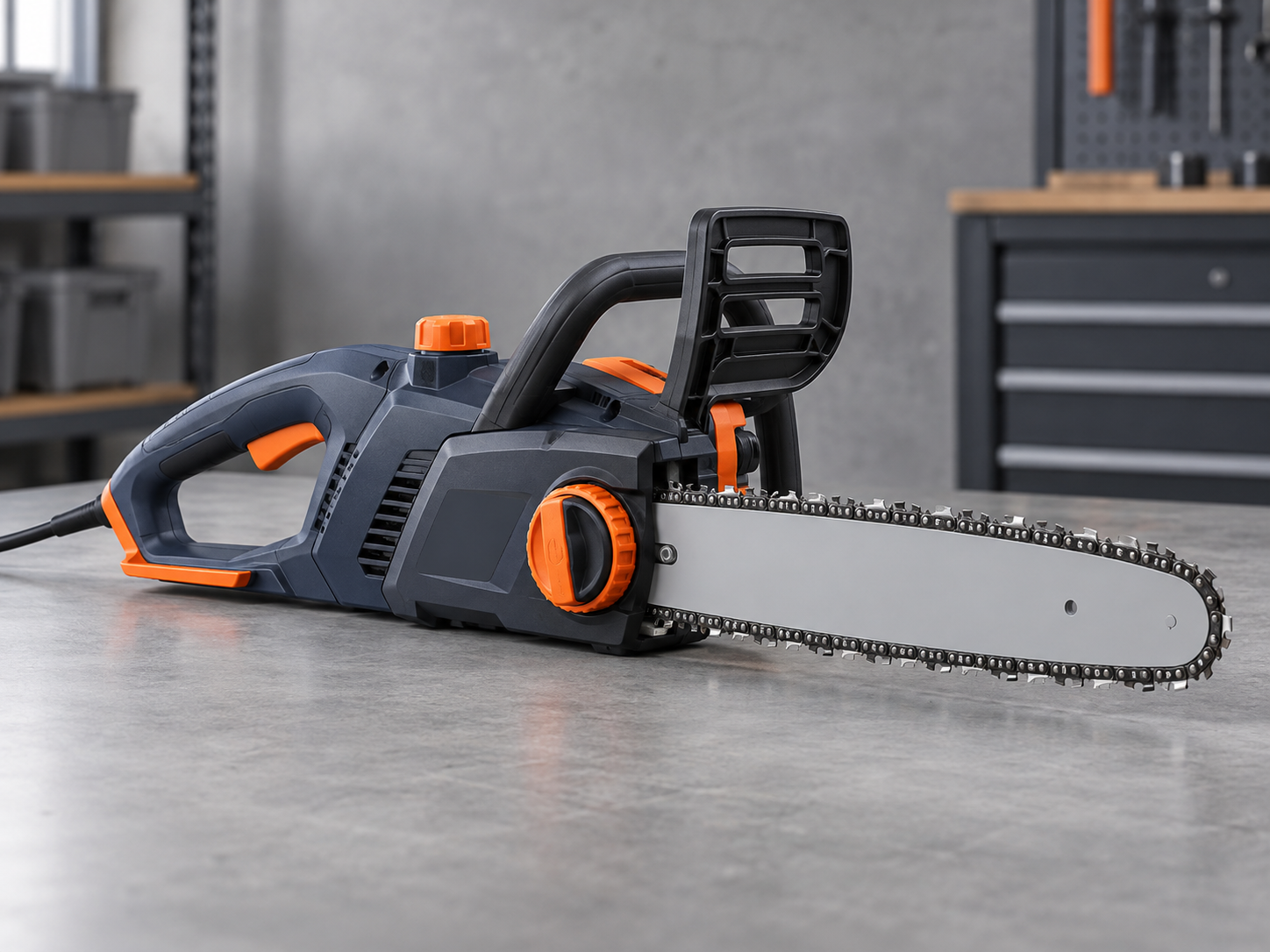
Caption: A protected bar, clean cutting system and correct power-source care support seasonal readiness.
Prepare the cutting system for idle time
The saw must be isolated from its power source before cleaning or inspection. Follow the manual for chain tension, bar removal, cleaning and any protective treatment. Sawdust packed around the drive area or bar oil hole can dry and harden, making a spring startup troublesome. Staff should not spray solvent into a tool or remove covers beyond the maker's user-maintenance instructions.
Inspect the chain for obvious damage, rust and wear. A dull or damaged chain should be sharpened or replaced according to the approved instructions before the next use, not left for the customer to discover at full power. Check the guide-bar groove and rails within the manual's maintenance scope. The guide-bar and chain selection guide explains why replacements must match the exact cutting system.
Oil handling deserves specific guidance. Some saws can leak small amounts of chain oil during storage because of temperature or pressure changes; other leakage may signal a fault. The manual should state the recommended tank and storage position for that design. A retailer should not promise that every electric saw is leak-free in every orientation. Provide a clean storage surface and an instruction for investigating abnormal leakage.
Keep battery care model-specific
For a battery saw, remove and store the pack as the manufacturer directs. Record any specified charge state, temperature range, refresh interval and charger precautions for the exact battery. Avoid copying a generic percentage or “charge every month” instruction from another platform. The pack's battery-management system and chemistry can change the appropriate procedure.
Inspect the pack enclosure and contacts before it returns to use. A swollen, damaged, unusually hot or wet pack should not be routinely charged. Isolate it and use the applicable incident process. Keep loose batteries protected from short circuits and away from conditions prohibited by their instructions. The cordless drill battery storage guide provides a distributor-level approach to battery inventory.
A retail demonstration battery is not the same as unopened saleable stock. It has a different cycle history and may spend months on a display. Give store staff a separate routine for demonstration units so they do not sell a used pack as new or leave a damaged pack on charge in the shop.
Check cable, plug and charger before spring use
For corded saws, the customer should inspect the cable, plug and strain relief as the manual directs. An outdoor extension cord, if used, must be appropriate for the saw and environment under the relevant guidance. A damaged cord or connector requires qualified service, not electrical tape and a test cut. The corded chainsaw extension-cord guide covers the associated retail instructions.
For battery saws, inspect the charger and its regional plug. A pack that does not charge may have a charger or connection problem rather than a defective cell group. A support team should record the charger model, indicator behavior and storage history before deciding. Never instruct customers to bypass a charger protection or open a battery enclosure.
At receiving or pre-season stock review, check that saleable kits still contain the right regional charger or cable. A long-held carton can be moved, opened for display or re-bundled, creating a mismatch that did not exist at factory dispatch. Inventory condition is part of the first-use experience.
Mid-article sourcing CTA: Preparing a seasonal electric-saw range? Send the saw platform, storage period and destination climate for a kit and after-sales information review.
Plan a pre-use inspection, not a blind startup
A responsible first-use card should ask customers to review the manufacturer's manual, inspect the cutting attachment, confirm chain tension and lubrication by the approved method, check the power source and wear suitable PPE. It should not replace the manual or teach risky cutting technique in a tiny flyer. A first cut should use a stable, appropriate workpiece and the maker's operating method.
If the chain is stiff, the oil system appears blocked or the saw behaves abnormally, stop and seek service. Running the tool “until it frees up” can damage the cutting system. If a stored battery fails to power the saw, do not repeatedly attempt to charge a visibly damaged pack. Route the case through trained support.
The first-use chainsaw checklist can be paired with a seasonal insert, but the two have different purposes. First-use explains a new kit; seasonal readiness addresses a known tool that may have aged, leaked oil or accumulated debris.
Use the return data intelligently
Record whether a spring complaint is about cutting, oiling, power, charging, cable, chain fit or cosmetic condition. Capture model, lot, purchase date, storage location, battery or charger identity and observed condition. “Does not start after winter” is not a root cause. Several returns from one lot may indicate a product issue; several returns from one dealer's damp warehouse may indicate a stock-care issue.
If a manual omits a common seasonal action, update the customer information for future units and notify existing owners through the appropriate channel. If an oil leak is consistently beyond the maker's expected behavior, request a supplier investigation. The goal is not to classify every problem as misuse but to let evidence direct corrective action.
At shipment inspection, check the carton includes the bar cover, manual and relevant accessories promised for storage. A practical storage guide is less credible if the kit omits the protective component shown in its photographs.
Distinguish retailer stock from a used customer's saw
Unopened warehouse stock and a used saw are not the same storage case. Retail stock should remain in its approved package and follow the supplier's inventory instructions. A used saw may have chain oil, debris, a worn bar and a battery with cycling history. Do not apply a “clean and disassemble” customer instruction to sealed inventory, or a warehouse carton procedure to a machine that has cut timber.
For a retailer, a preseason audit can sample long-held cartons for water damage, correct accessories, label readability and battery or charger identity. Any model-specific battery refresh should follow the pack instructions and be recorded by lot. If a carton has been opened for display, classify it separately and inspect it before deciding whether it remains saleable as new.
For the user, seasonal guidance should prioritize isolation, cleaning and the maker's storage position. It should be easy to locate in the manual or support page and should not include petrol-engine steps for an electric model.
Plan for different climates without inventing one rule
A saw stored in a dry indoor workshop faces different conditions from one left in a damp garden shed or a hot shipping container. The manufacturer should specify acceptable conditions for the tool and battery. A distributor can then translate those limits into local stock-care procedures. Avoid vague promises that a tool will tolerate any “winter” or “summer” temperature; actual ranges are model-specific.
Moisture can affect contacts, metal cutting parts and cartons. Direct sun can affect plastics and battery storage conditions. An importer should inspect its own warehousing route, including last-mile retailer stockrooms, instead of assuming the factory's clean test room represents the whole supply chain.
When a customer describes a storage environment outside the product guidance, support should still investigate the exact symptom rather than immediately assign blame. Packaging, instructions and product design may also need improvement.
Make a spring support flow
Start with a stop-use screen: visible battery damage, damaged cable, cracked housing, damaged chain or failed control should go to qualified service. For non-urgent questions, ask whether the saw is corded or battery powered, what changed during storage, and whether the bar, chain and oil system have been checked under the manual.
Do not ask a customer to repeatedly start a saw that will not lubricate or has an abnormal sound. A support agent can identify a missing oil fill or an incompatible charger from the record without a cutting demonstration. If a safe remote resolution is not possible, route the product to service and preserve its parts.
Tag the case with a specific symptom and outcome. A seasonal spike in “battery will not charge” may involve stock age, charger variant or genuine pack faults. A rise in “bar oil leak” may involve storage position or a changed seal. Better coding turns spring support volume into useful sourcing evidence.
Include a season-end kit in the assortment decision
A retailer can decide whether to offer a bar cover, approved chain oil, sharpening accessory and replacement chain alongside the saw. The kit should not imply that all products are included unless they truly are. A clear season-end checklist can point to these items without making the customer buy unnecessary parts. The commercial goal is a complete, understandable ownership path rather than a crowded box.
Ask how the storage guidance will reach users who bought online. It may appear in the manual, a support page and a seasonal email where consent permits. Keep each version consistent with the current model revision. If a battery platform changes, update the linked storage and charger advice rather than leaving the old page to circulate. A support article that is accurate only for a discontinued pack can create new problems.
Check the first use after storage
A season-end checklist should be paired with a season-start check. Before a stored saw is returned to service, the owner should follow the current model manual to inspect its condition, correct chain and bar arrangement, chain tension, lubrication supply, guards and controls. A battery pack should be examined and charged only as its maker directs. If a pack is swollen, damaged or behaves abnormally, it needs qualified handling rather than a trial charge.
Retailers can make this easy by linking the exact manual revision and listing the approved replacement chain, oil and battery for the model. A generic “ready for spring” banner is less useful than a short set of model-specific checks. If the saw or battery was stored in an unsuitable environment, support staff should avoid promising that a quick charge will restore performance; they should offer the maker's inspection and service route.
Keep the winter-storage communication separate from promotional claims. The purpose is to help an owner make a safe return-to-use decision and to identify damaged or missing parts before cutting. Any offered service package should state what is actually inspected and what remains outside its scope.
Frequently asked questions
Should an electric chainsaw be stored with its battery installed?
Follow the exact model's instructions. Many battery-saw makers advise removing the battery for storage, but the charging and storage conditions are battery-specific. Do not apply a petrol-saw procedure to a battery product.
Is a small oil mark under a stored saw always a defect?
Not necessarily; some systems can seep with temperature or pressure changes. Check the manufacturer's storage position and oil-tank guidance, and investigate unusual or persistent leakage.
Can a retailer start a stored saw to see whether the chain frees up?
Do not power a saw with an unknown or suspect cutting-system condition. Isolate it, inspect according to the manual and obtain qualified service where needed before a controlled test.
What should a seasonal support record include?
Record model and lot, storage period and conditions, power-source details, chain and bar condition, oil observations and the precise first-use symptom. This helps distinguish maintenance, accessory and product issues.
Conclusion
Seasonal readiness is a practical part of electric-saw ownership. A retailer can reduce confusion by providing model-specific cleaning, power-source and pre-use guidance, then classify spring returns with enough detail to find real causes. Generic winter advice is not enough when corded and battery systems differ.
Send your requirements
Share the intended saw platform, regional market and seasonal sales plan. ToolViron can discuss the manual, kit contents and stock-care checkpoints for a credible retail programme. Send your requirements to begin.

Caption: Bar cover, manual and power-source accessories should match the approved seasonal sales kit.
Images illustrate product and inspection topics; they are not documentary evidence of a specific ToolViron test or customer project. Confirm the exact model and market requirements before ordering.